

Research Spotlight: Using OMM to Manage Complex Regional Pain Syndrome
Student Doctor Nathaniel Santhany understands the benefits of osteopathic manipulative medicine (OMM) on a personal level. After the Rocky Vista University Montana College of Osteopathic Medicine (RVU-MCOM) second-year student was involved in a car crash when he was young, he experienced years of ongoing back pain and migraines. After receiving OMM care from an osteopathic physician, his symptoms improved. From then on, his interest in how OMM could potentially help other people with pain management followed him into medical school.
That’s why Santhany joined in to help Rocky Vista University College of Osteopathic Medicine (RVUCOM) third-year student Shaiva Patel on her research project that explores that possibility. The project focuses on whether OMM can help people with Complex Regional Pain Syndrome (CRPS) relieve pain symptoms and improve body functions.
CRPS and OMM
CRPS is “a condition that usually affects a limb (an arm or a leg) after an injury and causes ongoing pain that is much stronger even after the injury has healed,” according to the National Institute of Neurological Disorders and Stroke (NINDS). While it is an uncommon condition, patients with it can experience “changes in skin, temperature, nails, or hair along with unusual sweating.” In severe cases, “a person with CRPS can’t work or do their usual daily activities,” according to NINDS.
Evidence in medical literature supporting OMM as a treatment for CRPS remains limited, Santhany said.
“CRPS can have a substantial impact on quality of life, often limiting mobility, daily activities, and the ability to participate in physically demanding work or recreational activities,” Santhany said. “Despite its significant burden, CRPS remains challenging to treat, and patients may experience variable responses to conventional therapies.”
OMM is unique to osteopathic medicine training, according to the American Association of College of Osteopathic Medicine (AACOM). It is “used to treat structural and functional issues in the bones, joints, tissues and muscles of the body” and is defined as “the therapeutic application of manual pressure or force,” according to AACOM.
The Study
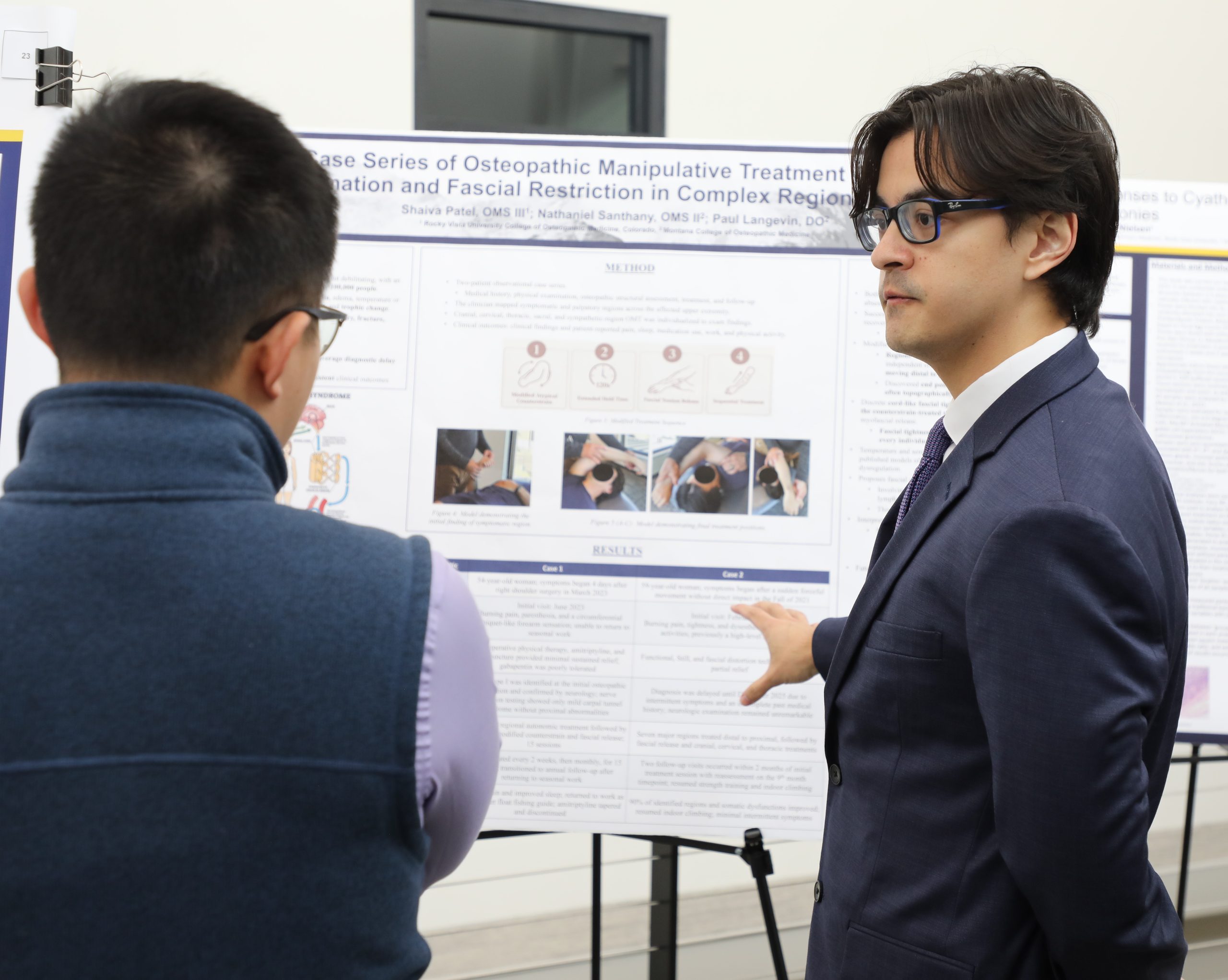
The research team worked closely with RVU-MCOM Assistant Professor of Osteopathic Clinical Sciences Paul Langevin, DO, DiMM, MPH. Dr. Langevin performed OMM techniques, particularly atypical counterstrain techniques combined with neuro fascial tension release, on two patients through his private practice. These patients experienced CRPS pain with little symptom relief from previous treatments. OMM sessions on each patient occurred over a year or more, depending on the patient.
“The research process involved reviewing the patients’ clinical histories, examining their treatment courses and reported outcomes, identifying common patterns in their responses, and organizing these observations into a case series,” Santhany said.
The atypical counterstrain technique used treats a specific part of the body in which the patient is feeling CRPS symptoms. The technique puts the body part in a physical position that eliminates symptoms and is then held for 90 to 120 seconds. Neuro fascial tension release involves palpating along the symptomatic body part, helping reduce tension in the body part’s fascia, or the complex connective tissue that arranges and coordinates all the functions in the body, according to Dr. Langevin.
“The hypothesis is that CRPS causes neuroinflammation along this tract, creating tension within the fascia the nerve runs through. This technique will alleviate this tension and allow better movement of the nerve through the fascia,” Dr. Langevin said.
After treatment, both patients saw improvement in their symptoms and were able to return to normal activities, including labor-intensive work and recreational activities like climbing.
“On a clinical level, we hope this case series encourages further investigation of an osteopathic approach that may be accessible to clinicians with appropriate OMM training,” Santhany said. “If future studies support its utility, this approach could potentially expand the adjunctive treatment options available to patients living with CRPS.”
A Team Effort
Santhany is quick to give credit to Patel for the project, who began the research a year ago. Patel initiated the patient-focused study, contributing to the project’s medical literature review, manuscript and abstract preparation, and poster development. Dr. Langevin was instrumental in the project, serving as the primary clinical mentor and advisor, as well as developing and implementing the treatment approach, Santhany said.
“We are especially grateful to Dr. Langevin for sharing his time and clinical experience, helping us understand the patient cases, and providing thoughtful feedback and edits throughout the development of our abstract, manuscript, and poster,” Santhany said.
The project wouldn’t have been possible without the patients, he said.
“We would also like to thank the patients for allowing their experiences to be shared for educational and research purposes,” he said. “Their cases made this project possible and highlighted the importance of continuing to explore treatment approaches for conditions that can be difficult to manage.”
Presenting the Research
Santhany presented the research poster during the Montana campus Fall Research Day on Oct. 17, an annual event that occurs on the Montana, Colorado, and Utah campuses in October and November. The RVU Office of Research and Scholarly Activity organizes the events, which celebrate student research, scholarship, and innovation.
The event gives students the opportunity to present their projects to a panel of judges for a chance to win research money. It also provides students with space to present their research posters to faculty, staff, and other students and receive feedback on how they can improve their presentation skills or their projects. Santhany said that the team plans to present their research at future conferences.
“We look forward to using the feedback from Fall Research Day to strengthen our presentation, address gaps in the information presented, and improve the project as we prepare for future dissemination,” Santhany said.
Why Research Matters
Santhany’s personal experience with OMM drives him to explore the ambiguity behind treatments and their clinical significance.
“Having personally received osteopathic manipulative treatment for approximately a decade, I have experienced its potential benefits while recognizing that we do not always fully understand the physiological mechanisms behind those effects,” he said.
Patel encourages other students to participate in research and contribute to the development of questions and ideas that could potentially improve patient care.
“I believe student involvement in research is important because it encourages critical thinking, strengthens our ability to evaluate evidence, and helps us become more thoughtful clinicians,” Patel said.
Research at RVU
Student research and scholarly activity are a vital part of the hands-on, real-world medical education experience that RVU emphasizes in our culture and curricula. Learn more about the impactful research RVU students are doing on the Peak News & Stories page on the RVU website.
Learn more about what research opportunities are available at RVU by checking out our Office of Research and Scholarly Activity.