

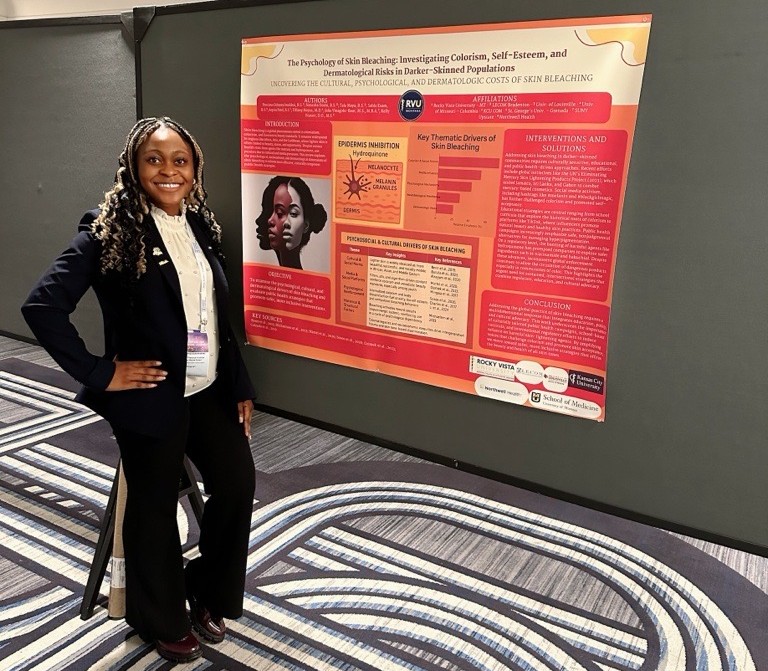
Research Spotlight: The “Why” Behind Skin Bleaching
Student Researcher Precious Ochuwa Imokhai and her team strive to make a difference through research.
Rocky Vista University Montana College of Osteopathic Medicine student Precious Ochuwa Imokhai believes that research goes beyond academia. She aims to make a difference with her research, which looks at the reasons why people use skin bleaching products and the health consequences of the practice. According to the World Health Organization, skin bleaching is defined as “the use of chemical substances to lighten skin tone or provide an even skin complexion by reducing melanin concentration.”1 Health risks include increased sun damage and skin cancer risk,2 skin dermatitis and sensitivity 3 and other issues. The research examines the historical, cultural, psychological, and neurobiological factors that influence skin-lightening behavior. Imokhai was raised in Lagos, Nigeria, and is a woman of Etsako-Esan heritage. As a woman of a darker skin tone, she witnessed colorism and skin bleaching firsthand. Colorism is “prejudicial or preferential treatment of same-race people based solely on their color.”4 With this research, she hopes to fill a gap in medical literature and shed light on the drivers of the practice.
The Study
The research was a team effort involving seven co-authors at different institutions across the country. The team looked at medical literature across “dermatology, psychology, neurobiology, and sociocultural studies.” They also analyzed research across “West Africa, the Caribbean, East Asia, Latin America, and the Middle East,” Imokhai said. The process began in December 2024, with the team finishing the project in mid-2025.
The team found that existing research focused primarily on “women in urban settings or specific regions like Africa and Asia,” overlooking “men, rural communities, and populations in Latin America and the Middle East,” Imokhai said. They also found a gap in the “why” of the practice, omitting the various reasons behind skin bleaching despite the health consequences.
Through their research, they found that drivers include social media algorithms and AI beauty filters. They concluded that skin bleaching was not only a cultural behavior, but one that increases dopamine, or in other words, initiates the brain’s “reward” response. This also has significant ties to Body Dysmorphic Disorder, or “a mental health condition characterized by obsessive focus on a perceived flaw in appearance – a flaw that others often cannot see – leading to repetitive behaviors and significant distress or impairment in daily functioning.”5 They highlighted that “darker skin tones remain critically underrepresented in dermatology training and clinical trials,” Imokhai said, and called attention to skin bleaching as a societal issue, rather than just an individual mindset. Educating consumers about the dangers of these products is not enough intervention, and that bigger societal and cultural changes need to be made, she said.
“I was drawn to this topic because it sits at the intersection of dermatology, mental health, and social justice, and because as a medical student, I want to be a provider who understands the cultural and psychological factors shaping my patients’ health decisions,” Imokhai said.
Team Effort
Imokhai worked with students and professors from other medical schools across the country to conduct the research. Student researchers included Tala Maya, BS from the University of Louisville School of Medicine and Sahla Esam, BS from the University of Missouri-Columbia School of Medicine. Faculty researchers included Natasha Doshi, DO from the Department of Psychiatry at Lewis Gale Medical Center, HCA Virginia; Arpita Patel, DO from Trinity Health; Tiffany Mayas, MD from the Department of Public Health and Preventative Medicine at St. George University; Julia Vinagolu-Baur, MS, MBA from SUNY Upstate Medical University; and Kelly Frasier, DO, MS from Northwell Health.
Imokhai is especially grateful to Amanda Brooks, PhD, vice provost of the RVU Office of Research and Scholarly Activity, for her mentorship on the project as well as the guidance from Dr. Frasier and Vinagolu-Baur.
“I appreciate you all for believing in my journey and always supporting me and my ideas; for supporting this work and providing a platform to elevate research on health disparities,” she said. “This topic is close to my heart, and I hope it sparks important conversations in our community about how beauty standards shape health outcomes.”
Presenting at the National Level
Imokhai has already presented the project at multiple conferences in 2025 but highlights the Brigham and Women’s Hospital (BWH) Dermatology Medical Student Virtual Research Symposium, the National Medical Association (NMA) Annual Convention & Scientific Assembly, and the American Academy of Dermatology (AAD) Annual Meeting. She has also won two awards for the research.
The BWH Dermatology Medical Student Virtual Research Symposium invites research that meets rigorous academic standards, where Harvard dermatology faculty, fellows, and residents offer critique and guidance, Imokhai said. The NMA convention allowed Imokhai to share the research with African American physicians, she said, and the AAD Annual Meeting gave her a way to share this important topic with the broader dermatology specialist community.
In the future, Imokhai looks forward to presenting at the Women’s Dermatologic Society Annual Meeting and the Skin of Color Society Annual Scientific Symposium, expanding the reach of the research to a broader audience. The research is in the process of being published, Imokhai said.
“My goal is to get this research in front of the clinicians and advocates who are best positioned to translate these findings into meaningful change for patients,” Imokhai said.
Why Research Matters
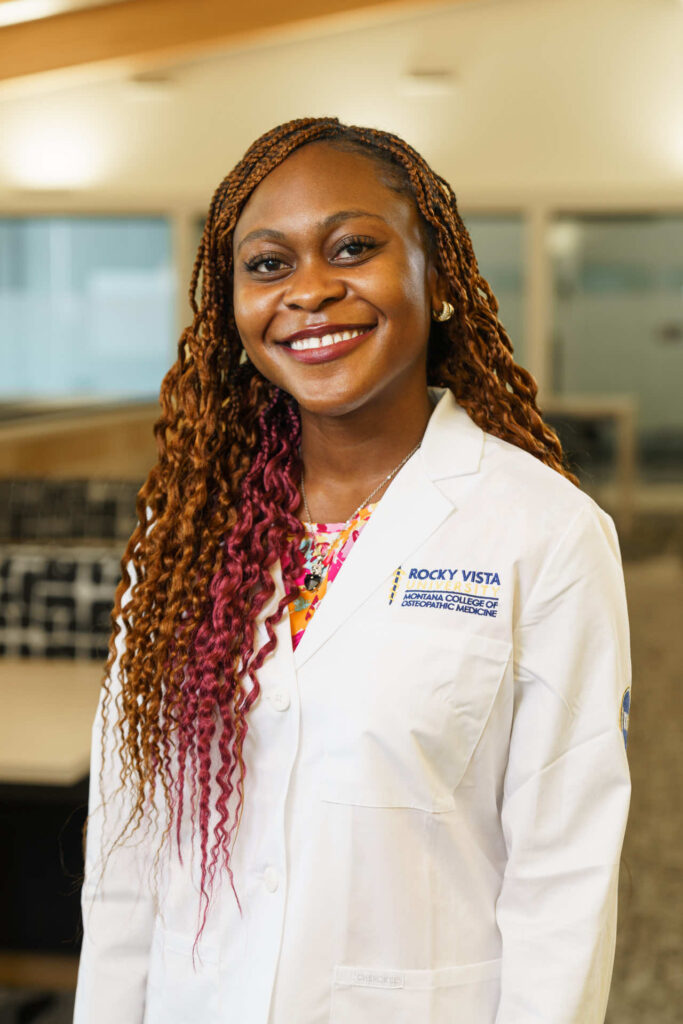
Imokhai grew up experiencing colorism and saw it reflected in everyday life, from products on store shelves to explicit comments on skin tone. She decided that through research, she would be able to validate the feelings of others and educate clinicians on the topic.
“Presenting this research has been one of the most meaningful experiences of my medical school journey,” she said. “Growing up Nigerian, I watched women I love reach for bleaching creams the same way others reach for moisturizer. I felt the sting of colorism personally.”
Imokhai hopes that this research helps clinicians understand their patients from various racial and ethnic backgrounds more fully, educating them on the signs of skin bleaching practices and the reasoning behind it.
Skin bleaching isn’t a cosmetic choice, she said, but a “behavior shaped by centuries of colorism, internalized racial trauma, and systemic inequity.” She hopes that her research will increase visibility on gaps in dermatological clinical training, enforce stronger regulations on skin-bleaching products, and help dismantle the cultural factors perpetuating the practice.
Research Opportunities for RVU Students
It’s important for medical students to participate in research early on in their education, Imokhai said, as it invites diverse perspectives and voices to address gaps in medical topics. It enhances clinical competency and encourages students to question assumptions.
“Research is also how we amplify the voices of communities that have historically been underrepresented in medical literature,” she said.
Student research and scholarly activity are a vital part of the hands-on, real-world medical education experience that RVU emphasizes in our culture and curricula.
Learn more about what research opportunities are available at RVU by checking out our Office of Research and Scholarly Activity.
Sources:
1. World Health Organization. (2011). Mercury in skin lightening products. WHO Press. https://www.who.int/initiatives/elimination-of-mercury-containing-skin-lightening-products
2. Abbas, K., Qadir, M. I., & Anwar, S. (2019). The role of melanin in skin cancer. Critical Reviews in Eukaryotic Gene Expression, 29(1), 17–24. https://doi.org/10.1615/CritRevEukaryotGeneExpr.2018024980
3. Ladizinski, B., Mistry, N., & Kundu, R. V. (2011). Widespread use of toxic skin lightening compounds: Medical and psychosocial aspects. Dermatologic Clinics, 29(1), 111–123. https://doi.org/10.1016/j.det.2010.08.010
4. Walker, A. (1983). In Search of Our Mothers’ Gardens: Womanist Prose. Harcourt Brace Jovanovich.
5. American Psychiatric Association. (2013). Diagnostic and Statistical Manual of Mental Disorders (5th ed.). American Psychiatric Publishing. https://doi.org/10.1176/appi.books.9780890425596